
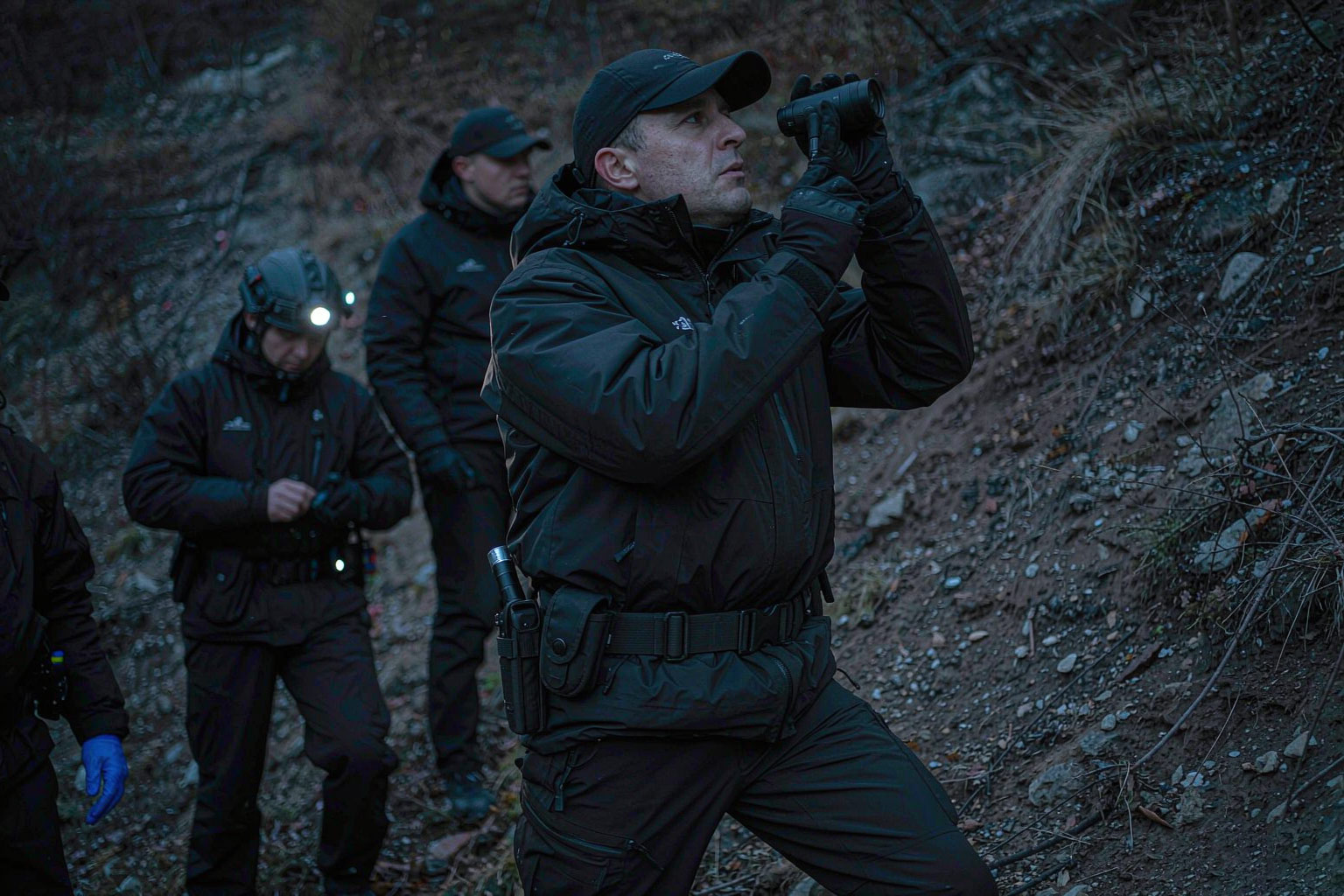
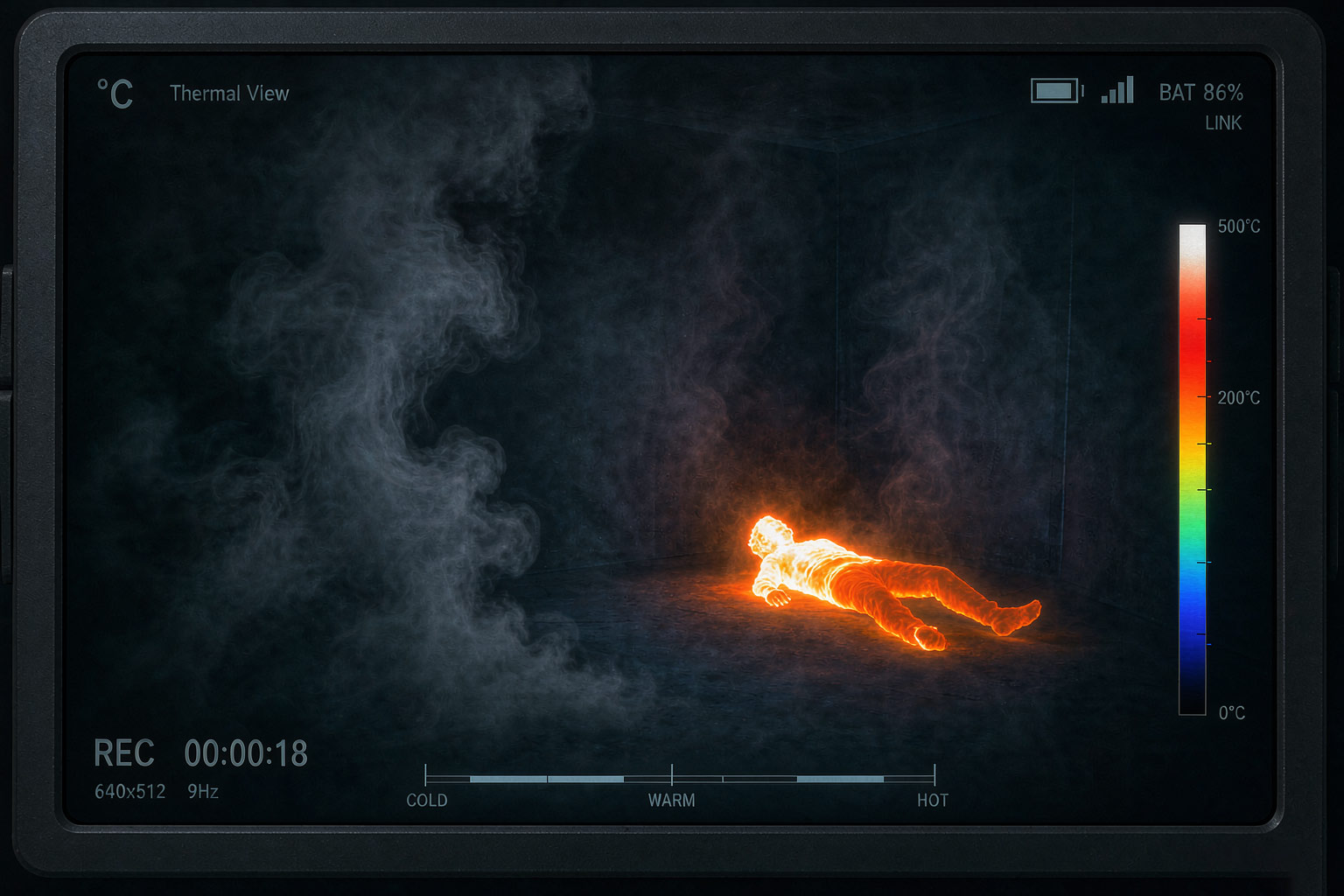
The deadliest threat in a fire scene is not the flames, but the thick smoke. Visibility in smoke often drops to less than half a meter — a high-powered flashlight only lights up a wall of white haze. The trapped victim may be collapsed just a few meters away in the corner, yet the rescue team can walk right past without ever seeing them. Thermal imaging solves one core problem and one only: making the invisible visible, even in an environment where human eyes can see nothing.
1. Why Thermal Imaging Works in Thick Smoke
Visible light and flashlight beams are scattered and absorbed by smoke particles, whereas the infrared radiation emitted by the human body has a longer wavelength that can penetrate dense smoke. Thermal imaging works on passive temperature-difference imaging and requires no light source at all: as long as there is a temperature difference between the victim’s body heat and the environment, a clear human-shaped bright spot appears on the thermal image. In extreme environments such as total darkness, thick smoke, and rubble crevices, this is often the only way to “see” a person.
2. Four Typical Use Cases in Fire Search and Rescue
Searching victims in smoke: After entering the fire scene, scan room by room to quickly locate fallen or curled-up victims — transforming “searching by touch along walls” into “searching by looking at images,” multiplying rescue efficiency.
Locating fire sources and smoldering spots: Hidden fire points inside walls, ceilings, and interlayers are invisible and untouchable, but they show up on the thermal image as abnormal high-temperature zones, preventing re-ignition.
Evacuation and reconnaissance: When retreating through thick smoke, thermal imaging can distinguish the outlines of doors, windows, passages, and the positions of teammates, reducing the risk of team members getting lost.
Extended post-disaster rescue: Locating survivors in earthquake rubble crevices, nighttime mountain rescue, and water rescue — all rely on the human thermal signature. One device covers multiple emergency scenarios.
3. Key Selection Criteria for Firefighting Thermal Imaging
High sensitivity: In thick-smoke penetration scenarios, temperature differences are small — only a high-sensitivity detector with NETD ≤ 25mK can bring out enough contrast.
High frame rate: During mobile searching, the image must not blur or trail. A 50Hz high frame rate is the practical baseline for real combat.
Reliability: High heat, water spray, and drops are the norm. IP67 protection and a rugged housing are indispensable; battery life must cover one complete rescue operation.
Hands-free options: Helmet-mounted thermal imaging frees up both hands, allowing firefighters to search, breach, and drag victims simultaneously — of enormous value in individual soldier operations.
4. From “Luxury Item” to “Standard Equipment”
In the past, thermal cameras were so expensive that a single fire squadron could afford only one or two units. As the cost of uncooled infrared detectors has dropped, handheld and helmet-mounted thermal imaging is moving toward squad-level or even individual-level deployment. For rescue operations, finding a trapped victim one minute earlier can be the difference between life and death — this is the fundamental reason thermal imaging has become “life-saving equipment.”
ELUNIT offers handheld and helmet-mounted fire-rescue thermal imaging devices, as well as infrared modules for OEM manufacturers, with support for custom solutions in the emergency rescue industry. If you need help selecting equipment for your rescue team, feel free to contact us.