
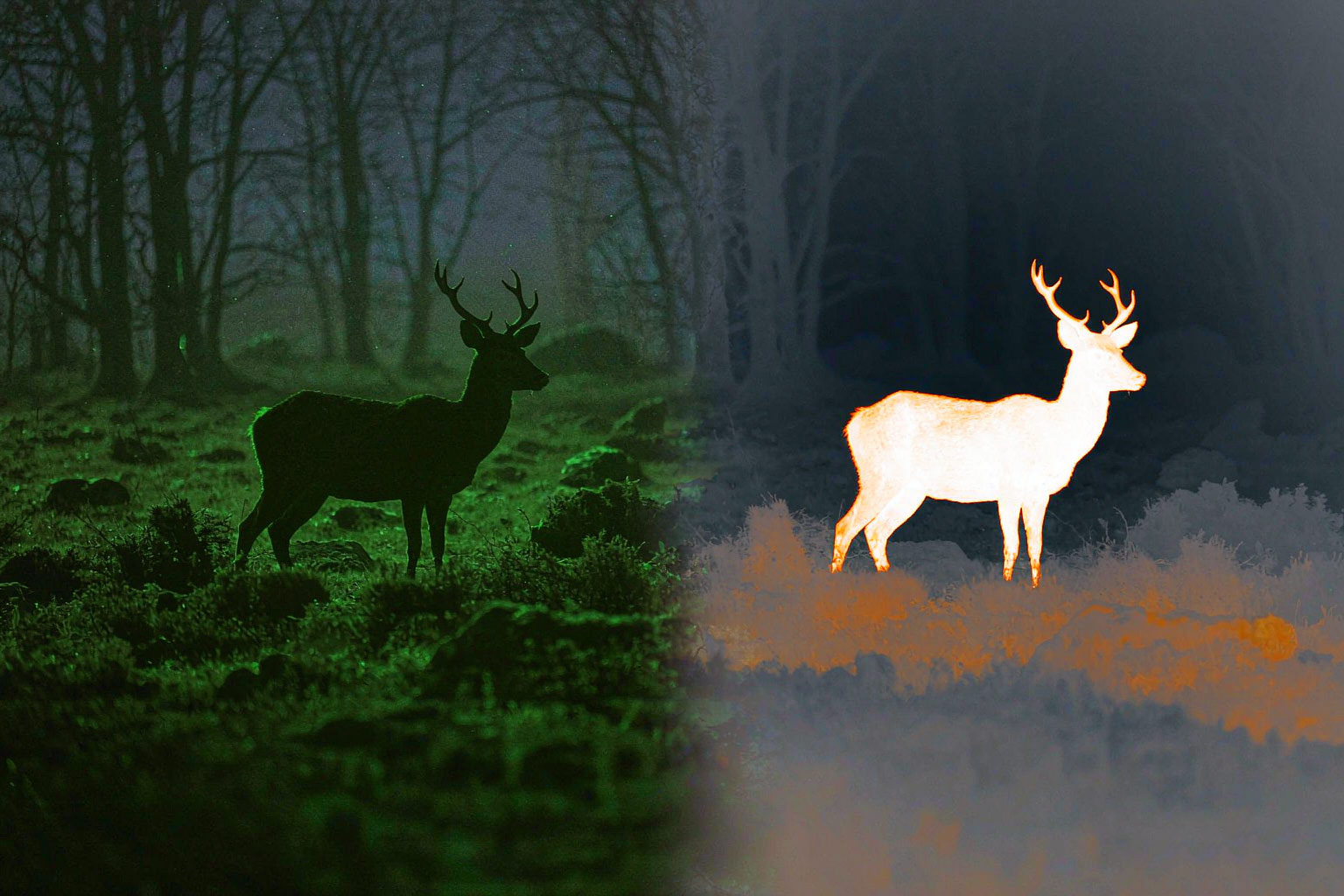
Wild boars are nocturnal — they lie low by day and come out after dark, destroying crops and injuring livestock. Any farmer or hunter who deals with them knows the feeling all too well: once night falls, you’re as good as “blind,” yet the instant you switch on a light, the game spooks and bolts. Thermal imaging has completely rewritten the rules of night hunting — in pitch-black conditions, a wild boar’s body heat is like a lantern that lights itself. But thermal imaging gear doesn’t come cheap, and a wrong buy is a lesson that costs you thousands. This article breaks down the 5 hard-and-fast specs you need to get right when choosing a thermal imaging device — all in one read.
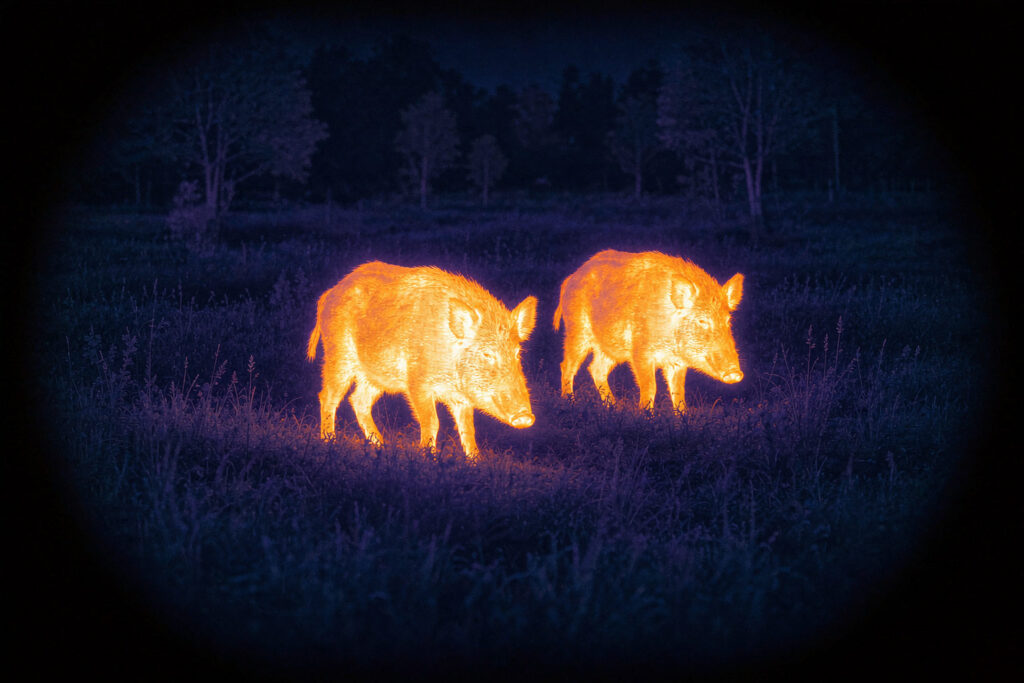
Spec 1: Resolution determines “how clearly you see”
The mainstream tiers are 256×192, 384×288, 640×512, and 1280×1024. Wild boar night hunting typically takes place at 100–400 meters: the 256 tier suits close-to-mid range observation and entry-level users; the 384 tier is the cost-performance sweet spot for night hunting; the 640 tier can still tell the difference in body shape between a boar and a deer beyond 300 meters; the 1280 tier is built for precise long-range identification. Remember one principle: resolution isn’t about buying “seeing farther” — it’s about “seeing more clearly at the same distance.”
Spec 2: Thermal sensitivity (NETD) determines “what you can tell apart”
After rain, in high humidity, or on chilly late-autumn mornings, the temperature difference between a boar and the ground gets compressed — that’s when thermal sensitivity makes or breaks your image. NETD ≤25mK is the practical baseline for night hunting; high-sensitivity units at NETD ≤20mK deliver visibly cleaner images and sharper target edges in foul weather. Devices without enough sensitivity look fine on a clear day, but the moment rain or fog moves in, the image smears into a blur.
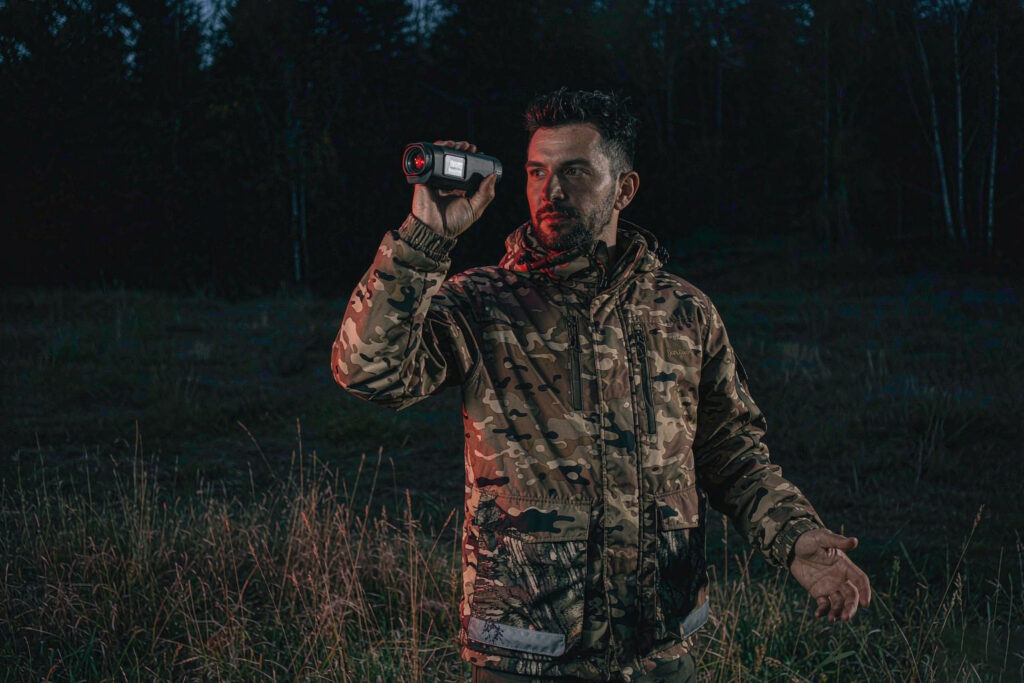
Spec 3: Know the difference between detection distance and recognition distance
The “2,000-meter detection range” on the marketing page means spotting a heat signature. But the recognition distance — at which you can confirm “that’s a wild boar, not a bush” — is often only a fraction of that figure. When choosing, leave 1.5–2× of margin over your typical shooting distance: if you usually work within 200 meters, a unit with a 300–400 meter recognition distance is all you need. Don’t pay extra for specs that only look good on paper.
Spec 4: Frame rate and shutter design determine “how well you keep up”
Wild boars are moving targets. Below 25Hz, images visibly smear and stutter; only a high 50Hz frame rate lets you track a running herd smoothly. Also check whether it uses a shutterless design: traditional mechanical shutters “click” every few minutes, freezing the image for recalibration — and that freeze could land exactly when you should be pulling the trigger. A shutterless design keeps the image continuous with no interruptions, a real, tangible advantage for night hunting.